
Domestic · Ealing, London

Re-roof scaffolding, Ealing

  • Ealing, London
  • Domestic scaffolding

The job

What we built

A row of neighbouring houses in Ealing, scaffolded front and rear so their roofs could be stripped and re-covered. Each property gets an independent scaffold tied back into the building, with the working lift set just below the eaves, guardrails and toe boards to the open edges, mesh brickguards across the top lift and debris netting over the whole working face. Standards stand on timber sole boards to spread the load across garden ground and paving, and are sleeved in padding where people pass close by. Access is by ladder behind a hinged gate at the lift, with a ladder guard clamped over the stile at the bottom. A gin wheel rigged off the top lift takes the stripped tiles down and the new materials up.

  • Independent scaffolds to the front and rear elevation of each property
  • Working lift boarded out at eaves height, with guardrails and toe boards
  • Mesh brickguards and debris netting across the working face
  • Standards on sole boards, sleeved in padding at ground level
  • Ladder access behind a hinged gate, with a ladder guard to the bottom stile
  • Gin wheel rigged for striking the old tiles and landing the new

The job

Why a re-roof needs a scaffold, not a ladder

A re-roof is one of the few domestic jobs where the whole working surface disappears. The tiles come off the full slope, the battens and felt behind them come off with the tiles, and for a stretch of days the roof is open with people working right at its edge. There is nothing to stand on that was not built for the purpose, and nothing to stop a tile that gets away from someone.

That is what the scaffold is for. A boarded lift set just below the eaves gives the roofers a platform the full width of the elevation, at a height where the roof edge is at hand rather than overhead — close enough to work the verge and the fascia without stretching, low enough that the ridge is still reachable from the slope. It also gives somewhere to put things down, which matters more than it sounds on a job that generates a roof’s worth of old tile.

On this run of houses the same thing happened at each property in turn, front and rear. Every elevation carries its own independent scaffold, tied back into the brickwork rather than leaning on it, so no part of the structure depends on a roof that is about to be taken apart.
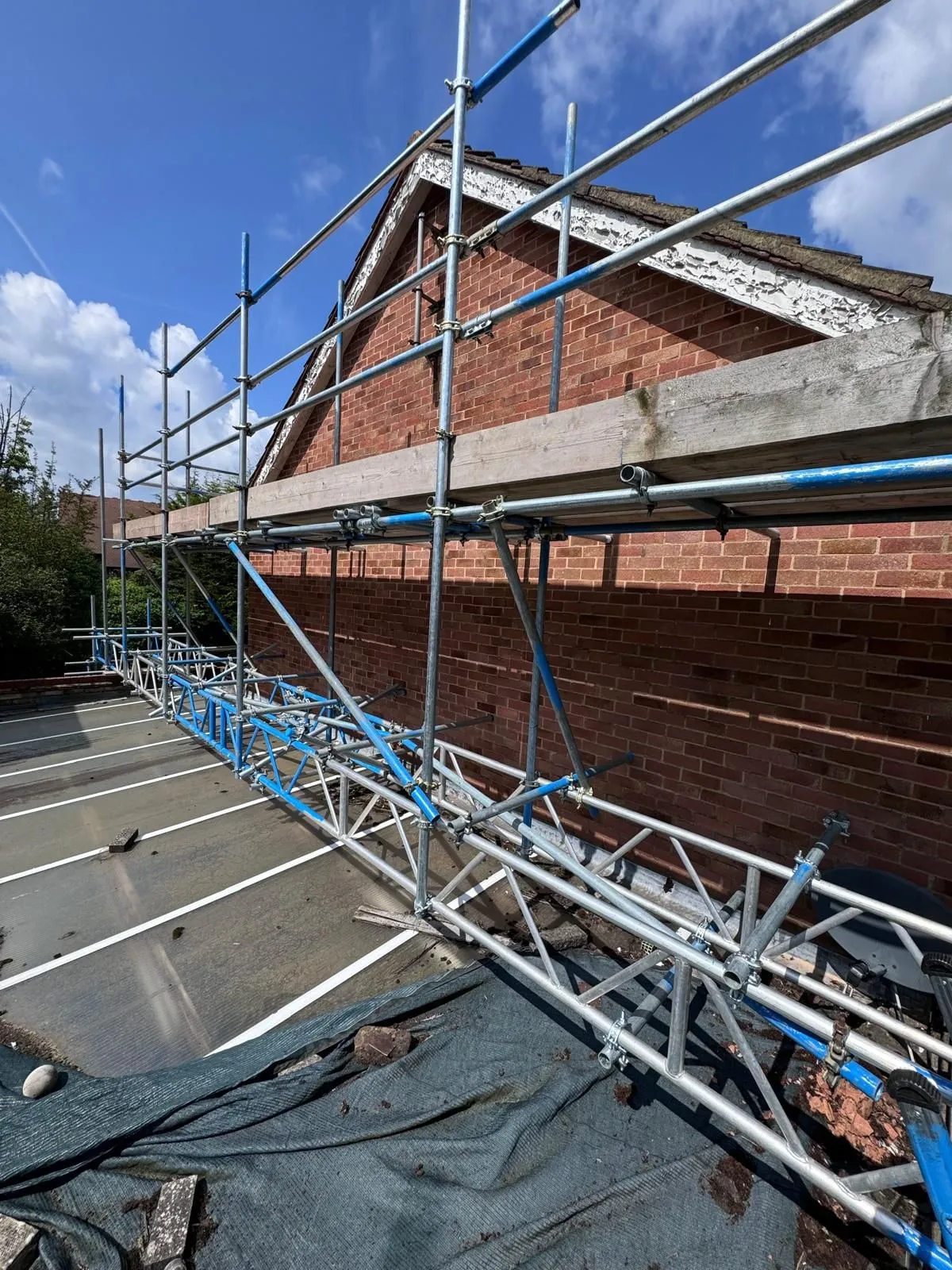

Edge protection

What the working lift actually carries

The platform is the obvious part. The rest of the lift is there to stop things leaving it. Guardrails run at the open edges with toe boards at deck level, and mesh brickguards fill the gap between the two so a tile slid across the boards meets something solid rather than fresh air. Above that, debris netting is run across the full working face — it catches the dust and the small stuff that guardrails never would, and it keeps the wind off the people working behind it.

All of that matters more on a re-roof than on most jobs, because of what is coming down. A stripped roof produces a continuous stream of old tile, felt and batten, and it produces it directly above a garden, a path or a neighbour’s boundary. The edge protection is the only thing standing between that material and whatever is underneath.

Getting it down is a separate problem again. A gin wheel — a rope and pulley rigged off the top lift — lets the old tiles be lowered in loads rather than carried down a ladder, and takes the new ones back up the same way. It is the oldest piece of kit on a scaffold and still the quickest way to move a roof’s worth of material without anyone carrying it.

Ealing

Scaffolding a house in Ealing

Ealing’s housing is mostly interwar and postwar suburban — semis and short terraces, rendered or pebbledashed, with hipped tiled roofs, front gardens and long gardens behind. It is stock that reaches the age where a roof needs doing all at once rather than patching, which is why re-roofs tend to come in runs along a street rather than one at a time.

It is also stock that is mostly set back from the road. Where a scaffold stands wholly within the garden and nothing oversails the footway, it is a matter between us and the householder. The moment any part of it stands on or over the public highway — the carriageway, the footway or a verge — Ealing Council requires a licence for the temporary structure and expects to be notified before work starts. They ask for a minimum width of 1.2 metres to be kept clear for pedestrians, take a deposit against damage to the street, and want a renewal in before the first licence runs out if the job is going to overrun it. On a red route, Transport for London has to agree the application before the council can.

We deal with all of that — the application, the conditions that come back with it and the renewal if the roof takes longer than planned. There is more on working across the capital on the London scaffolding page, and on access scaffolds for houses under domestic scaffolding.

Access

Getting up, and keeping everyone else off

Access is by ladder to the lift, tied and set at the right pitch, through a hinged gate that closes the guardrail line behind whoever has just come up. At the foot of the ladder a ladder guard is clamped over the stiles and padlocked, carrying a DANGER DO NOT CLIMB sign. On an occupied street that is not a formality: a scaffold standing in a front garden overnight is an invitation, and the guard is what makes the ladder unusable to anyone who is not supposed to be on it.

At ground level the standards sit on timber sole boards rather than straight onto lawn, border or paving, which spreads the load instead of driving it into one point — the difference between a scaffold that comes down leaving nothing behind and one that leaves four holes in a lawn. Where a standard lands beside a path or a doorway it is sleeved in padding, so the thing people walk past in the dark is soft and visible rather than bare steel.

Scaffolds are inspected before they are first used, after anything that could have affected their stability, and at intervals of no more than seven days while they remain up. Each one is tagged with the result, so anyone about to climb it can see at a glance that it has been checked and when.

Weather

When the roof has to stay open

A stripped roof and a wet forecast are not compatible, and on a re-roof the two meet constantly. Sheeting pulled over the open slope off the scaffold buys a night or a weekend, which is usually all that is needed between stripping a slope and getting the new covering on it.

When the work is bigger than that, or the weather is against it for longer than a sheet will hold, the answer is a temporary roof — a scaffold-borne structure over the whole building that turns an open roof into a covered one, so the work underneath carries on regardless. It is the same scaffold doing a different job, and whether it is worth it is a decision made at the survey rather than halfway through a wet week.

Common questions

Scaffolding for a re-roof in Ealing — asked and answered

  • Do I need a licence for scaffolding in Ealing?

    Only if the scaffold stands on or over the public highway — the road, the footway or a verge. If it sits entirely within your own garden or driveway, no licence is needed. Where one is, Ealing Council licenses it as a temporary structure and expects to be notified before work starts; they usually require a minimum width of 1.2 metres to be kept clear for pedestrians, and they take a deposit against damage to the street. On a red route, Transport for London has to approve it before the council can. We apply, deal with the council and build to whatever conditions come back, and we will tell you at the survey which case applies to your house.

  • How long will the scaffold be up for a re-roof?

    As long as the roofing work takes, plus the time to strike it. That depends on the size and shape of the roof and on the weather, so we do not publish a standard figure — we agree the hire period with you before anything goes up, and if the job overruns we extend it, including renewing a highway licence where one is in place.

  • Will the scaffold damage the garden or the driveway?

    The standards stand on timber sole boards rather than directly on lawn, borders or paving. That spreads the load over a wider area instead of concentrating it under each leg, which is what prevents the sinking and the divots a scaffold can otherwise leave. On block paving and other soft ground we take extra care over how the base is set out.

  • Can we still get in and out of the house?

    Yes. The scaffold is set out so doors and paths stay usable, and where a standard has to land close to a doorway or a path it is sleeved in padding so it is soft and visible to anyone passing. If something about your access makes that difficult, it is worth raising at the survey, because it is far easier to design around than to move afterwards.

  • Do you scaffold the back of the house as well as the front?

    For a re-roof, usually both. The roof has two slopes and both of them need stripping and re-covering, so each elevation gets its own independent scaffold with its own working lift and edge protection. Rear elevations often take more setting out than fronts, because of extensions, conservatories, gardens and boundaries to work around.

  • Is the scaffold inspected while it is up?

    Yes. Scaffolds are inspected before first use, after any event that could have affected their stability, and at intervals of no more than seven days for as long as they stay up. Each scaffold is tagged with the result of the last inspection, so anyone about to use it can see that it has been checked and when.

Re-roof scaffolding, Ealing, Ealing, London

Need a quote?

Talk to the people who will actually be doing the job. Tell us what the work is and roughly when you need access, and we will come and price it properly.

  • Free, no-obligation
  • Surveyed before priced
  • Written quote, hire period included

Alpine Scaffolding The team who survey, price and build it

Rather talk it through? 07736 250 242
Call now 07736 250 242 WhatsApp Text us Quote